





Tessa Arias, Chef and Cookbook Author
This post may contain affiliate links. Read our disclosure policy.


One of the first things we learned in my baking class in culinary school was how to temper chocolate.
I was SO excited to learn because it always really intimidated me.
Turns out, it’s actually easy. All it takes is a little practice, precision, and patience.
Learning how to temper chocolate is the key to shiny, smooth chocolate that snaps when you break it and stays firm at room temperature (no refrigeration required).
I’ll walk you through the exact temperatures, best chocolate to use, microwave and seeding methods, and how to fix common mistakes so your chocolate sets perfectly every time.
Reader Love
We made this today, for Valentine’s family activity. We had so much fun!
I tempered in microwave. Followed every step and it worked. Thank you so much. They turned out delicious and pretty. Thank you so much.
–

Sprinkle of Science
What does it mean to temper chocolate?
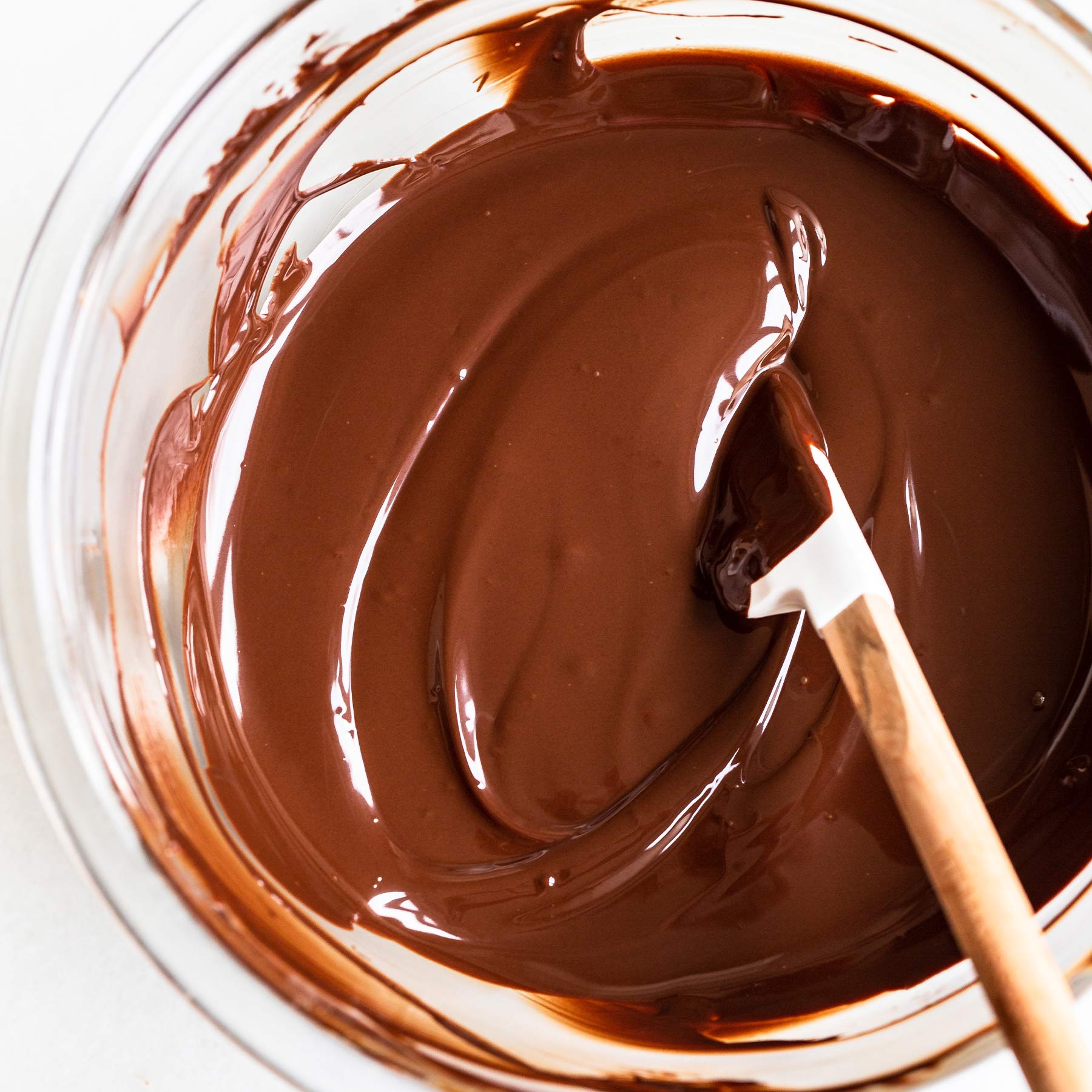
Tempering chocolate is the process of heating and cooling chocolate to specific temperatures so the cocoa butter forms stable crystals.
When properly tempered, chocolate:
- Sets firm at room temperature
- Looks shiny and smooth
- Snaps cleanly when broken
- Resists white streaks (fat bloom)
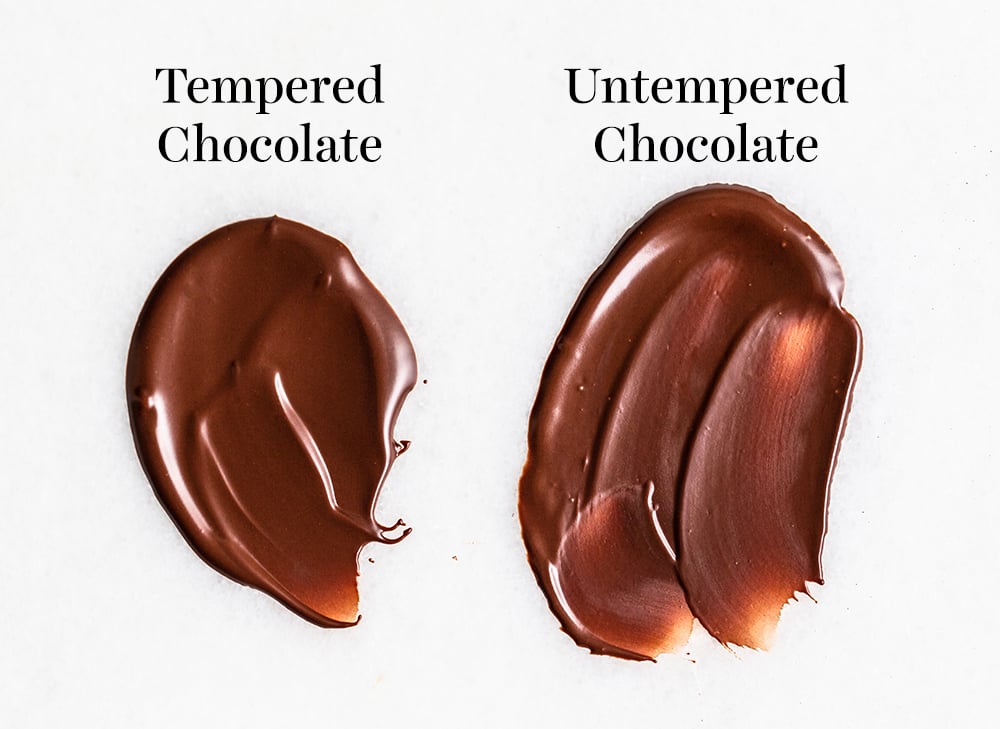
Without tempering, melted chocolate dries dull, soft, and streaky — and often needs refrigeration to stay firm.
I’ve included two methods for tempering chocolate in the recipe card below: stovetop and microwave.
Why & When to Temper Chocolate
If you’re dipping strawberries or making homemade candy like truffles or peanut butter cups, tempering gives you a professional finish, without adding stabilizers or refrigerating.
If you’re simply adding chocolate to brownies, mousse, or ganache, tempering is not necessary.
Two Rules for Melting Chocolate
These apply whether you’re melting or tempering.
1. Don’t Overheat It.
- Dark chocolate: never above 120°F
- Milk or white chocolate: never above 110°F
Overheating damages flavor and prevents proper crystal formation.
2. Keep Water Away.
Even a drop of water will cause chocolate to seize and turn grainy.
If your recipe includes butter, liqueur, or coffee, melt it together with the chocolate — not after.
Best Chocolate for Tempering
Use high-quality baking bars or couverture chocolate, NOT chocolate chips.
Good options (chop finely with a serrated knife):
Best option (no chopping required!):
DO NOT use chocolate chips. They contain stabilizers to hold their shape, which interferes with smooth tempering.
For a full breakdown, see my Chocolate in Baking Guide.
Do you need a thermometer?
Yes. I strongly recommend one.
Tempering is about precise temperature control. Guessing increases failure risk — and chocolate isn’t cheap.
A digital instant-read thermometer works perfectly.
Baking Success Tips
- Temper at least 16 ounces.
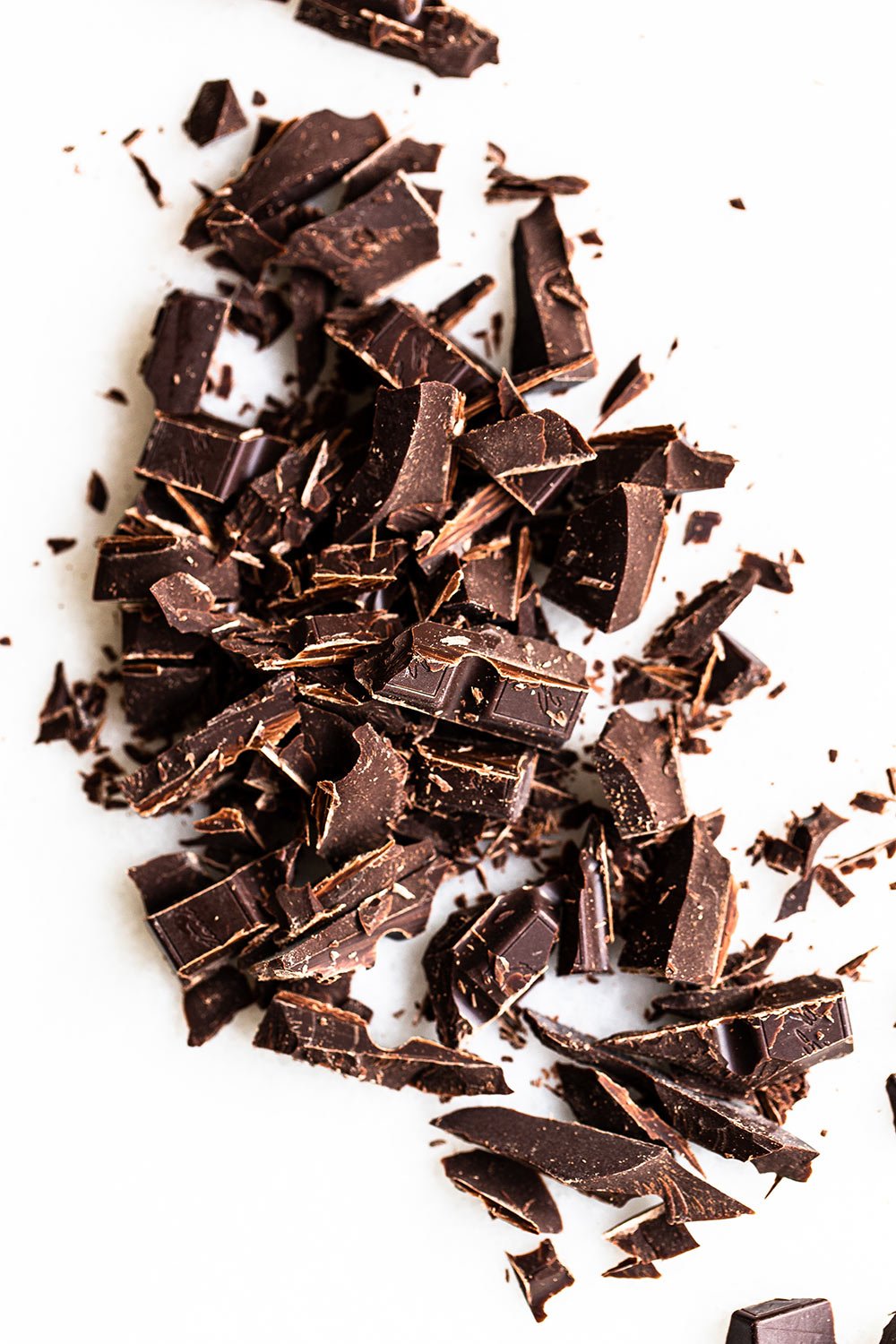
- Finely chop chocolate for even melting.
- Avoid glass bowls if possible, they retain heat longer.
- Work in a cool, low-humidity room.
- If chocolate thickens too much, gently rewarm to working temp.
- If temperature rises too high, add more chopped chocolate.
- Don’t refrigerate finished dipped items unless necessary.
Storage & Make-Ahead
Tempered chocolate can be reheated and re-tempered multiple times.
Store tempered chocolate creations at a cool room temperature in a dark dry environment. Do not refrigerate unless absolutely necessary.
FAQs
The process involves controlling the melting, cooling, and reheating of chocolate within specified temperature ranges depending on the kind of chocolate.
The goal of tempering chocolate is to ensure the development and longevity of Form V crystals, one of the six types of cocoa butter crystals.
This type of fat crystal is stable and contributes to the coveted textural properties of a delicious chocolate treat!
Maintaining and controlling the development of Form V crystals is also crucial to avoid the unpleasant white, chalky appearance that can form on chocolate when recrystallization occurs.
A double boiler is simply a heatproof bowl set over a saucepan filled with about an inch of simmering water.
You just want to make sure the bowl on top doesn’t touch the water.
This allows the chocolate to be melted gently by the heat.
You can use metal or glass bowls for the top part of the double boiler.
Glass will take longer to cool down as required to temper in Step 2.
I don’t recommend it. They contain added ingredients to help them hold their shape and have a lower concentration of cocoa butter, which will interfere with smooth tempering.
Yes, but not for tempering. The way to fix seized chocolate is completely counterintuitive. Stir in a little bit of melted butter, oil, or water back into the mixture. The fixed melted chocolate should only be used for chocolate sauce or hot chocolate and not for tempering.
Streaks usually mean the chocolate wasn’t fully tempered or the temperature went too high. Reheat gently, add more seed chocolate, and repeat the cooling process.
Dark chocolate should be worked at 88–90°F, milk chocolate at 85–87°F, and white chocolate at 82–84°F. These temperatures maintain stable crystals without melting them.
‘Chocolate’ candy melt products available at many stores produce a similar crunchy coating when dipped. However, most chocolate compound products aren’t actual chocolate because the cocoa butter has been replaced by hydrogenated industrial oils. They taste artificial and don’t provide the same satisfaction.

Email This Recipe
Enter your email, and we’ll send it to your inbox.
Ingredients
- 16 ounces (454 grams) baking chocolate, finely chopped
Instructions
Tempering Chocolate by Seeding:
Tempering Chocolate by Seeding:
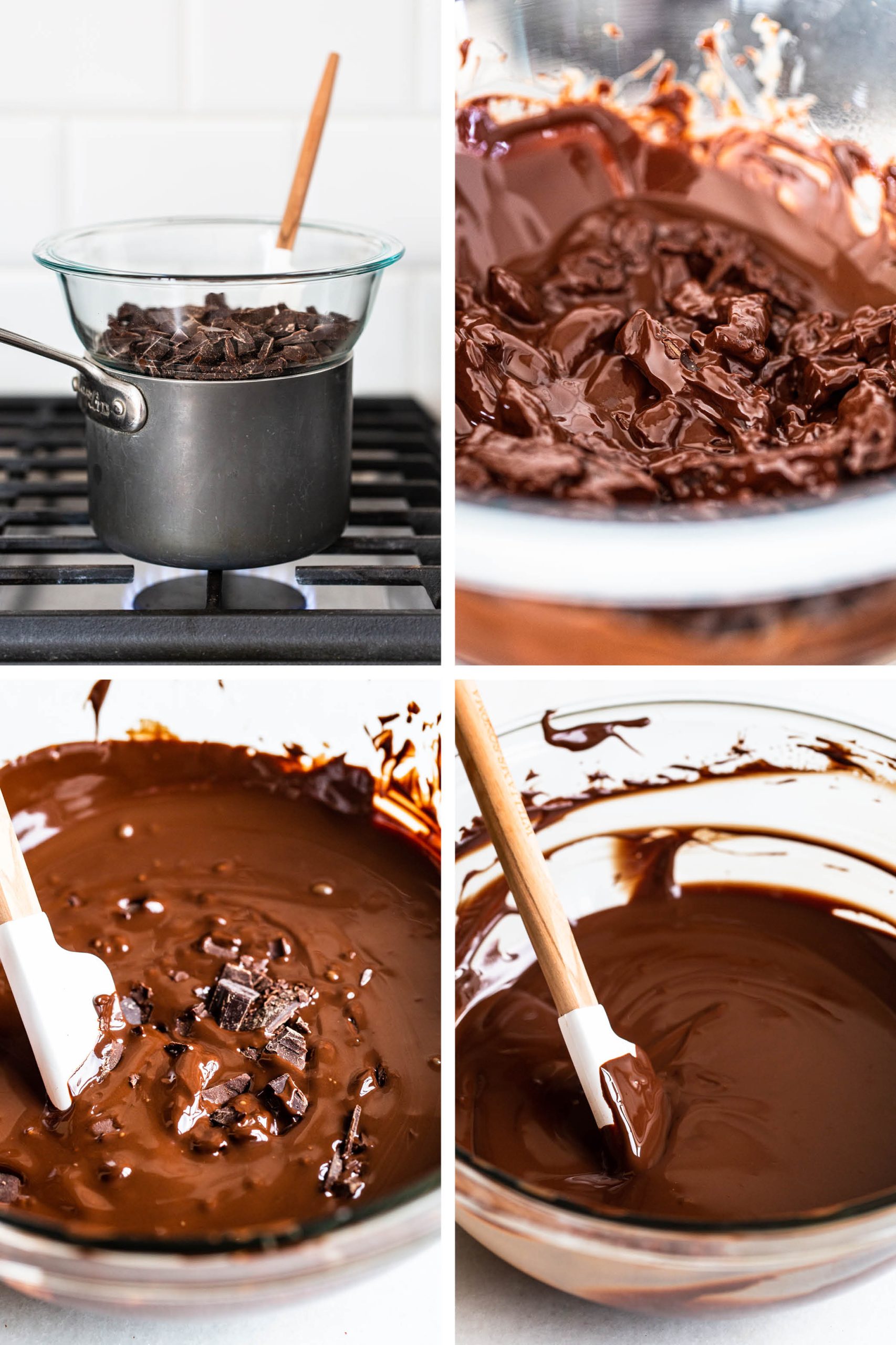
- In a double boiler, melt 2/3 of the chocolate, stirring often, until the thermometer registers around 115°F, but absolutely no higher than 120°F. If tempering milk or white chocolate, heat to 110°F. Remove from the double boiler. Make sure all equipment that comes in contact with the chocolate remains completely dry. Any water will cause the chocolate to seize.
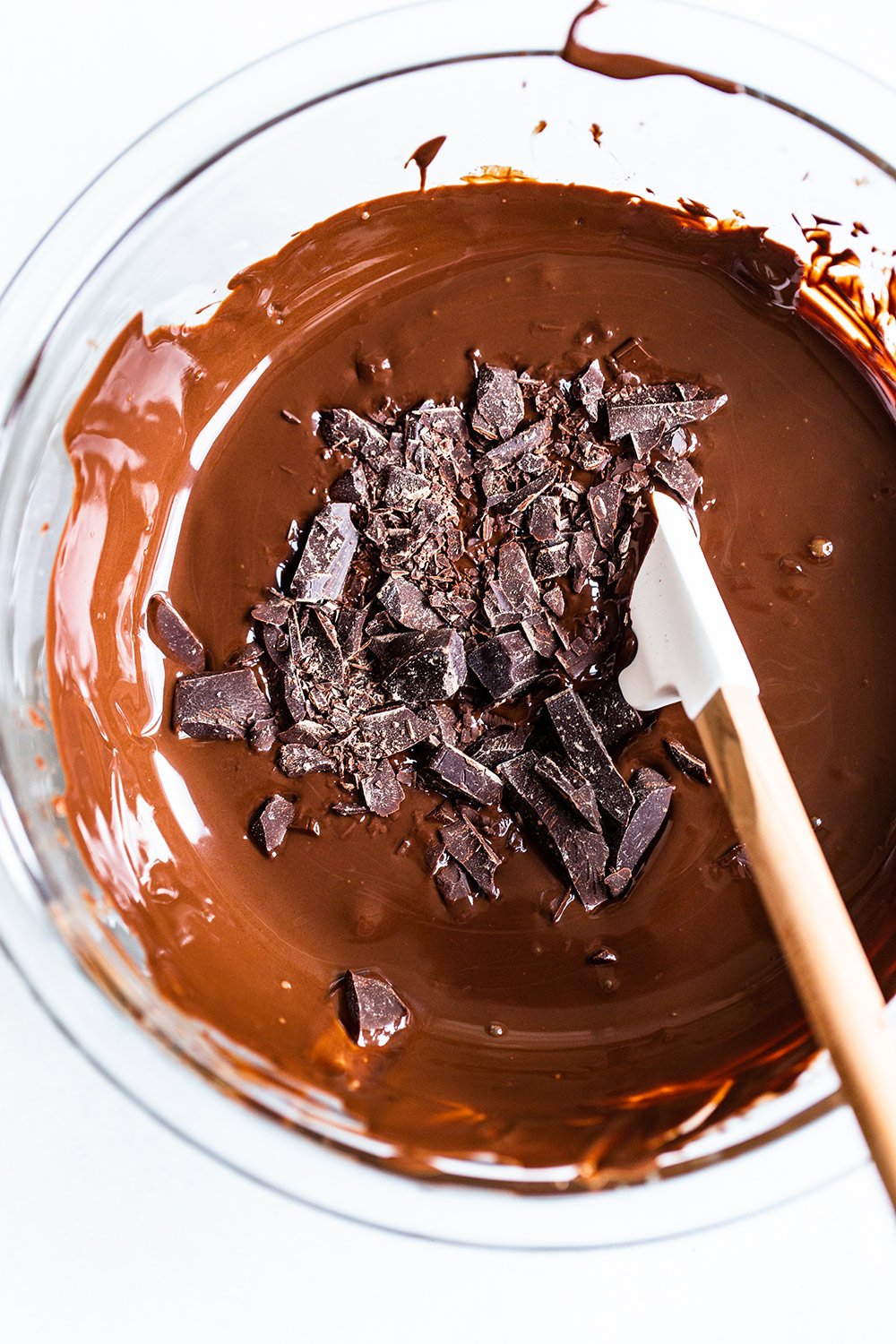
- Gradually seed in the remaining chocolate to bring the temperature down, stirring vigorously and constantly. Stir until the temperature drops to 84°F. This can take some time, usually about 15 minutes, so just be patient – it will come down to temperature! A glass bowl will take longer to cool. Speed this process up by carefully placing the bowl of chocolate into an ice bath, making sure not to get ANY water in the chocolate.
- Reheat the chocolate briefly by placing the bowl back over the double boiler for 5 to 10 seconds at a time, stirring, until it reaches 89°F. This is the “working temperature.” Do not leave the chocolate over the water or let it exceed 91°F.
- You’re done! Test your temper by dipping a small piece of parchment into your chocolate. Let it sit at room temperature for a few minutes. The chocolate should be smooth and firm. If it’s streaky or runny, try stirring in more chocolate to the mixture to bring the temperature down further.
- Tempered chocolate can be tempered over and over again. You want to keep the working temperature of about 89°F when working with it. If it goes far below that temperature, set it back over the double boiler until it is 89°F again. If it goes much above that temperature, add more seed chocolate to drop the temperature.
Tempering Chocolate by Microwave:
Tempering Chocolate by Microwave:
- Put 2/3 of the chocolate in a microwave-safe bowl. Melt at 50% power in 1-minute intervals, stirring between each interval, until melted and smooth. The chocolate should only be between 100 – 110°F.
- Add remaining chocolate in small amounts while stirring. Be sure that the pieces are completely melted before adding more.
- The chocolate will thicken and become cool, shiny, and smooth as you continue stirring and “seeding” it by adding additional small amounts. When it has reached the range 84-91°F, the chocolate will be tempered and ready to work with.
Notes
Fun Uses for Tempered Chocolate:
This post was originally published in 2013 and updated with more tips and new photos in 2020 and 2023. Photos by Ashley McLaughlin.
Article Credits:
- Written by Tessa Arias
- Edited by Jessie Bruce, Master’s of Public Health Nutrition and Dietetics Candidate at UC Berkeley
Sources:
- Industrial Chocolate Manufacture And Use (2009). In Beckett S. T. (Ed.), (Fourth ed.). United Kingdom: Blackwell Publishing Ltd.
- Amendola, J. (2002). Understanding Baking: The Art and Science of Baking (3rd Edition). Wiley
- Global Education US. VitalSource
- Brenner, M., Sorensen, P., & Weitz, D. (2020). Science and Cooking: Physics Meets Food, From Homemade To Haute Cuisine (First ed.). New York, NY: W. W. Norton & Company, Inc.
- Lonchampt, P., & Hartel, R. W. (2006). Surface bloom on improperly tempered chocolate. European Journal of Lipid Science and Technology, 108(2), 159-168.
doi: Wiley - McWilliams, M. (2016). Foods (8th Edition). Pearson Education (US). VitalSource
- Reaver, A. (2021, Nov. 10). Lipids II – classification, function [Course Lecture]. Introduction and Application of Food Science, University of California, Berkeley, Berkeley, CA, United States.
- Culinary Institute of America. (2022). Tempering Chocolate for Homemade Candy. Retrieved March 20, 2022, from CIA Foodies


Terrific information! thank you. Very clear clear instructions.
One quick question; if you temper minimally a pound of chocolate at a time but you don’t use it all, then how do you reheat that tempered chocolate at a later date to use it up??
Thank you, Sylvia
If I need my chocolate to be runny can I still use the microwave to temper it? Also, I’m not sure if I can control the way my microwave heats (I don’t have an option for 50% power) so how many seconds should I heat it?
Hi Tessa! Can I use 70-80 percent cocoa chocolate bars…. Like Lindt or other good quality chocolate. Or, dark cooking chocolate…. I can’t get baking chocolate where I am. Also, can you do a video for chocolate almond brittle please
Whatever chocolate you start with should already be tempered (otherwise it would be super unstable and wouldn’t have much of a shelf life), so as long as you’re using chocolate wafers/bars made for baking and not just for consumption, you should be good to go. Great suggestion for a possible future recipe, you never know what Tessa will come up with 🙂
You make it easy for we beginners
Hi Tessa
Thanks for a great video. Just wanted to check whether the temperatures are the same for milk and dark chocolate?
Thanks 🙂
How do we do this without a thermometer?
Short and Sweet Demonstration!
Thanks, Nancy
Yeah, thanks. Nou I also know what peanutbuttercups are! I’ll experiment with peanutbutter, butter and powdered sugar!
Yours Katja
Funny I was thinking about learning how to properly temper chocolate the other day! Great timing 😉
Oh, ok – so if you’re starting out with untempered chocolate, you’d need tempered chocolate to seed? Or are all wafers/chips/bars tempered from the get-go?
Whatever chocolate you start with should already be tempered (otherwise it would be super unstable and wouldn’t have much of a shelf life) so as long as you’re using chocolate wafers/bars made for baking and not just for consumption (like Hershey’s bars or something), you should be good to go. I included a link in the post of my favorite chocolate to use for tempering. In this video I just used Baker’s brand semisweet baking chocolate. Hope that helps!!
Hey Tessa, Love this! Question – does the seed chocolate need to be tempered, or is it the same chocolate you use for melting?
Thanks Stephanie! The seed chocolate is the same you used for melting, which should have been tempered when it was manufactured for sale. Make sure to use high quality chocolate that is dark and shiny (no chocolate chips or anything with added waxes, etc).
They look yummy! Can you do a brownie video soon? Also, your makeup is gorgeous here! Any chance you can do a makeup tutorial sometime? 🙂
Thank you for the requests! I’ll definitely consider doing a brownie video and a makeup video would be fun too because I’m slightly makeup obsessed. Check out this Sunday’s post, it’ll be all about my recent beauty faves!
I will try it. I am eating my truffles naked, ok, straight from the bowl with a spoon. So dipped would be a step up.. Thanks so much for this