




Tessa’s Recipe Rundown
Taste: Balanced sweetness with a subtle tang from sour cream and a touch of lemon and vanilla for an elevated flavor.
Texture: Ultra smooth, creamy, and dense without being heavy. The crisp crust offers the perfect contrast for the filling.
Ease: A little more advanced but totally doable thanks to all of the tips I’ve included.
Why You’ll Love This Recipe: It’s been kitchen-tested with meticulous detail so you know it’ll turn out.
This post may contain affiliate links. Read our disclosure policy.





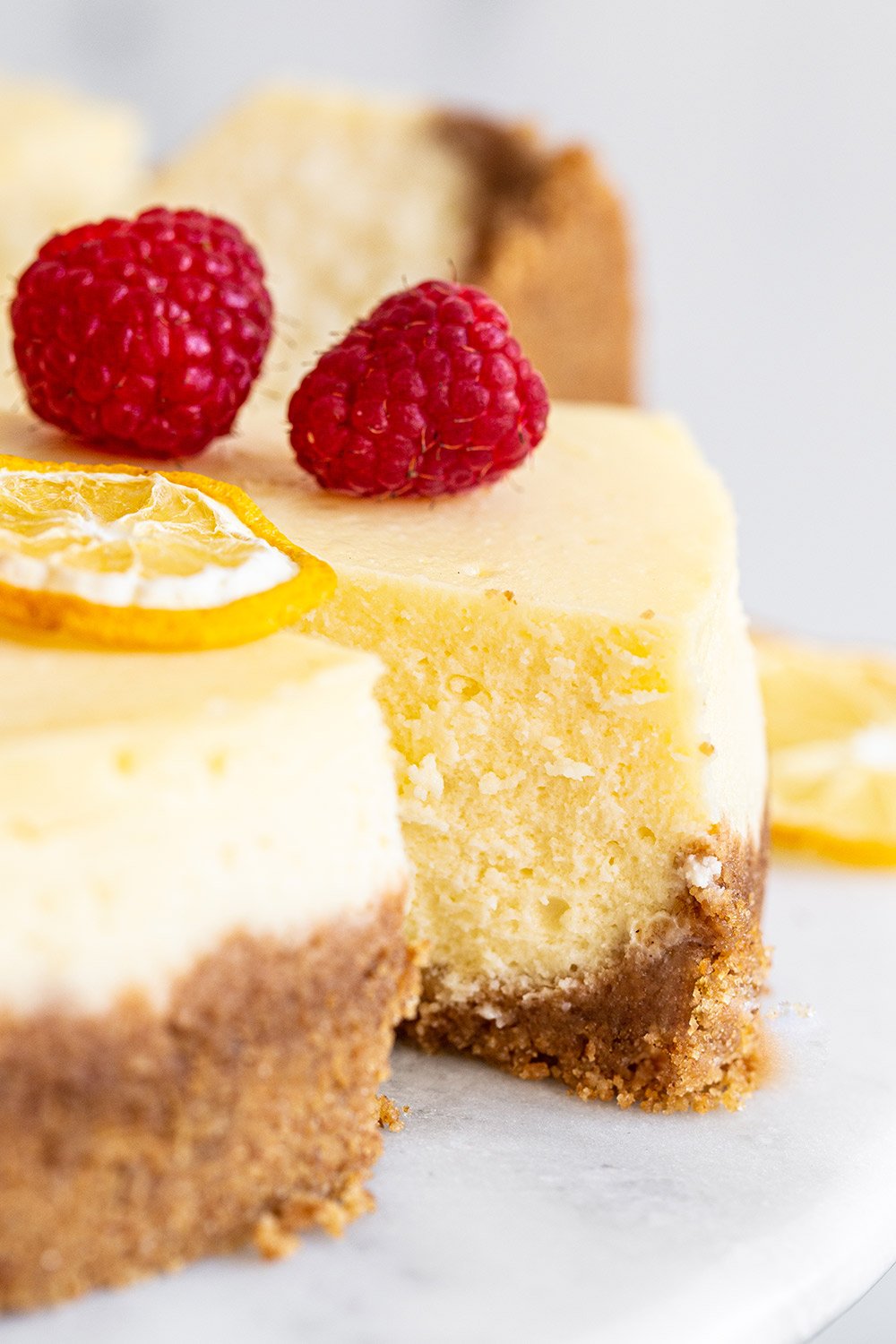
This is THE cheesecake recipe. The one you will want to make again and again!
The texture is rich and luscious, the flavor is sweet and tangy, and the gentle water bath ensures bakery-level results every time. If you’ve ever wondered how to make cheesecake that looks as good as it tastes, this recipe is the winner.
Reader Love
I made this cheesecake recently, and I’m STILL thinking about it. It was that good! Whomever reads this and may still be feeling intimidated by making it, do not fret! Just take it slow, and do every single process. Have fun, enjoy the steps and it’ll turn out wonderful!
–
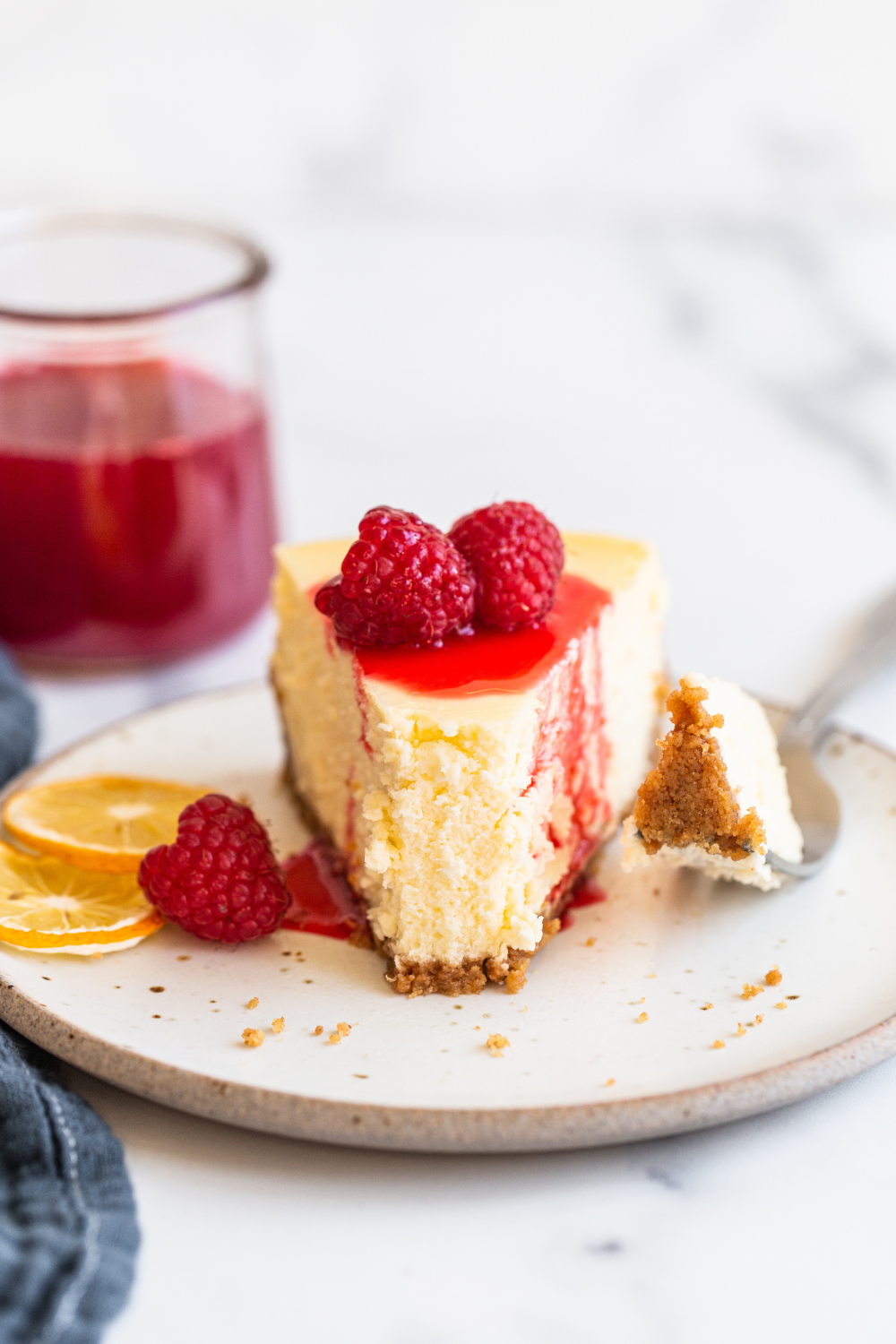
This recipe is the perfect centerpiece for any birthday party, Easter, or Christmas dessert. People will be asking what fancy bakery you went to!

Sprinkle of Science
Ingredient Notes
There are a few key ingredients that make a world of difference. Here’s what you need to know to be successful.
Cream Cheese
Use brick-style, full-fat cream cheese only. Spreadable cream cheese contains more air and stabilizers, which can create a gummy texture. In my testing, lower-quality brands baked up slightly watery and rubbery. I prefer Philadelphia. Let it soften completely to room temperature for a smooth batter.
Sour Cream
Adds tang and creates a silkier texture. You can substitute full-fat plain yogurt, but avoid anything low-fat which can cause excess moisture.
Lemon Zest + Juice
This does not make lemon cheesecake. It enhances the tang and balances the richness. If you skip it, the flavor will be flatter.
Eggs
Provide structure. Make sure they’re room temperature and add them last, mixing just until combined to prevent incorporating too much air (which leads to cracks). I have yet to find a suitable substitute for the eggs.
Graham Crackers
I provide both the cup measurement of total cracker crumbs and the weight so you can swap in Biscoff, vanilla wafers, or digestive biscuits if desired.
How to Make Cheesecake (Step-by-Step)
1. Prepare the Pan + Water Bath
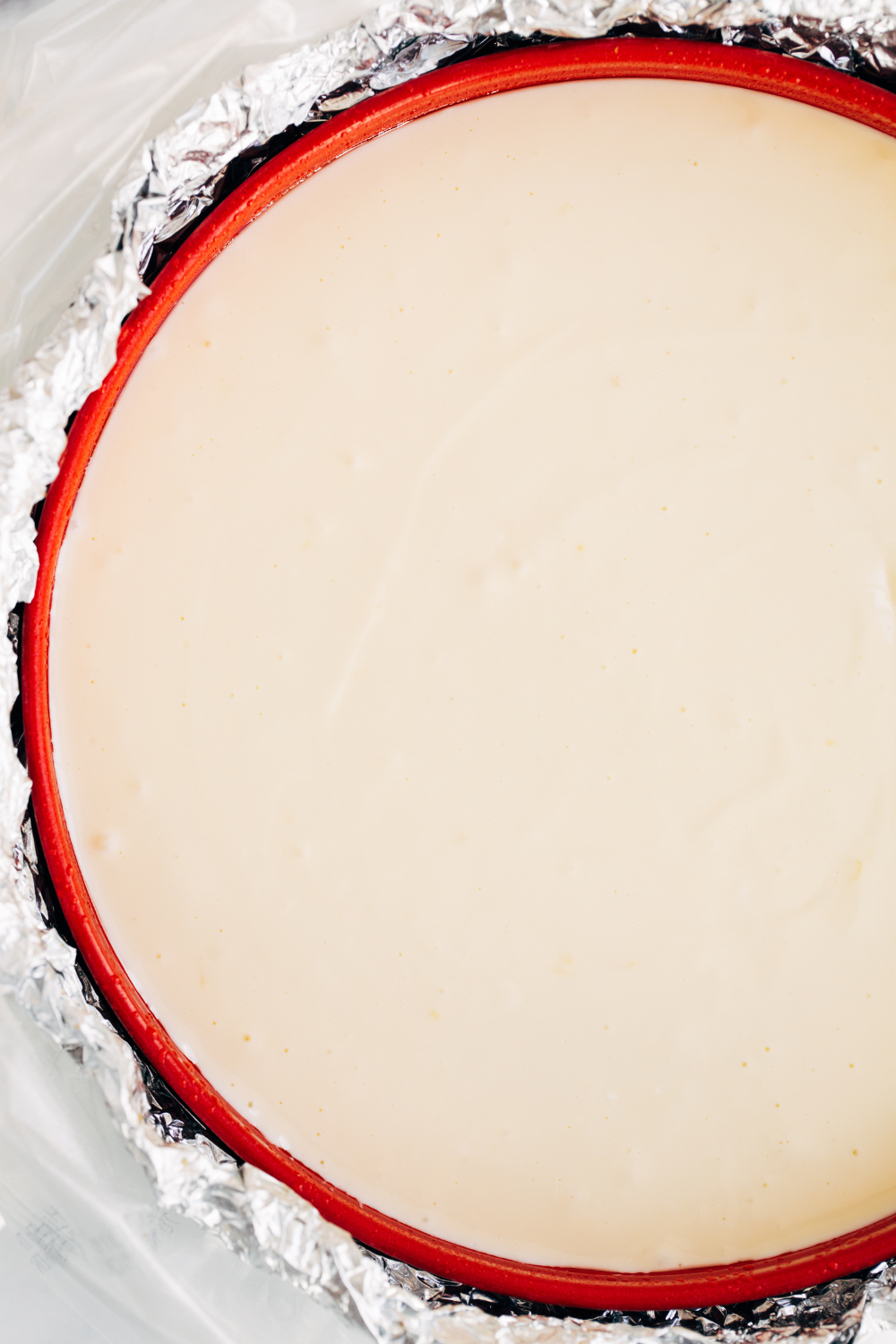
Preheat oven to 325°F. Wrap a 9-inch, 10-cup springform pan in three layers of heavy-duty foil. Spray lightly with nonstick spray.
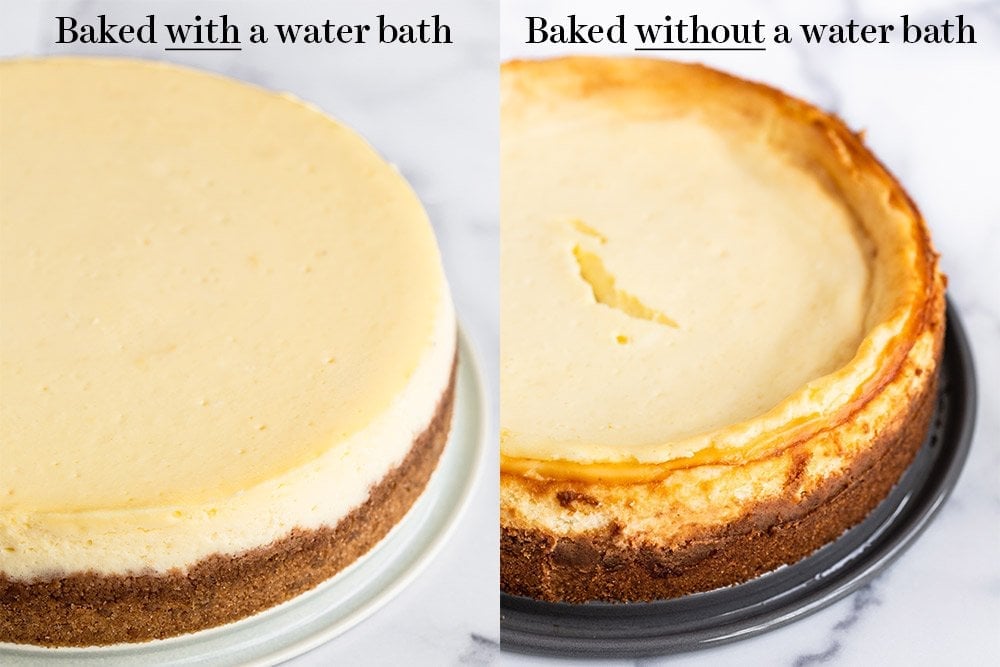
This prevents water from seeping in. You can also wrap the pan inside an oven-safe roasting bag to prevent leaks. Learn more about water baths here.
2. Make the Crust
Combine graham cracker crumbs, sugar, and melted butter. The texture should resemble wet sand.
Press firmly into the bottom and halfway up the sides of the pan. Bake for 10 minutes. The crust should look slightly darker and smell toasty.
3. Beat the Cream Cheese
Beat softened cream cheese on medium speed until completely smooth. Scrape the bowl thoroughly. This step matters, any lumps now will stay lumps later. Add sugar and beat until smooth.
4. Add Flavorings
Mix in sour cream, lemon zest, lemon juice, and vanilla. Scrape the bowl again.
5. Add Eggs (Gently!)
Add eggs one at a time, mixing on low just until combined. Do not overmix after adding the eggs otherwise you may incorporate too much air which can lead to cracks.
Tap the pan on the counter to release air bubbles. Pour batter over the cooled crust into the pan.
6. Bake in a Water Bath
Place the filled springform pan inside a large roasting pan and place on the middle rack. Carefully pour boiling water halfway up the sides.
Bake for about 1 hour 15 minutes.
The cheesecake is done when:
- The edges look set and slightly dry.
- The center jiggles like Jello.
- The internal temperature reads 150°F.
Do not wait until the center is fully firm, that’s overbaked. The edges should not wobble, only the center. The gentle cooling process will continue to cook the cheesecake through the center.
7. Cool Gradually
Turn off the oven. Crack the door open 1 inch (use a wooden spoon to prop it open if needed) and cool inside for 30–60 minutes. This gentle cooling prevents cracks.
Remove from water bath, unwrap foil, and run a thin knife around the edge.
Cool completely to room temperature, then refrigerate at least 5 hours or overnight before slicing.
Storage & Make Ahead
This cheesecake will last for 3 days in the fridge. Any longer and the crust will become mushy.
To freeze, wrap the whole chilled cheesecake or slices tightly in plastic and place in a freezer bag for up to 2 months. Thaw overnight in the refrigerator.
FAQs
I’ve included both the volume measurement of the graham crackers and the weight measurement, so you can swap in any other crushed cracker, cookie, or biscuit. Some other cheesecake crust ideas:
– Vanilla wafers
– Digestive biscuits
– Speculoos / Biscoff cookies
– Amaretti cookies
There’s just enough lemon zest and juice to brighten this very rich cheesecake and enhance the tangy flavor. Don’t worry, it doesn’t taste like lemon cheesecake.
This particular cheesecake recipe requires a 10-cup, 9-inch diameter springform pan like this one.
Not all springform pans are made equally. You want one that’s heavy-duty and sturdy. Avoid dishwashers. Hand washing will extend the life of a springform pan.
Just because your pan is 9-inches in diameter doesn’t necessarily mean it has a 10-cup batter volume capacity. Every brand may vary slightly. Luckily for this recipe, the batter can stand close to 1/4-inch from the top of the pan since it won’t rise much in the oven thanks to the water bath.
Use a water bath, avoid over-mixing the eggs into the batter, bake to 150°F internal temperature, and cool gradually. Cracks are almost always caused by overbaking, over-mixing once the eggs are added, or sudden temperature changes.
Yes, bake in two standard-sized muffin tins lined with paper or foil liners. Divide crust mixture evenly among cavities and bake at 325°F for 5 minutes. Set aside to cool. Fill with cheesecake batter and bake for 17 to 20 minutes – no water bath needed. Allow to cool completely, then chill in the refrigerator overnight.
Chocolate ganache
Salted caramel sauce
Butterscotch sauce
Whipped cream
Fresh fruit
Fruit compote

Email This Recipe
Enter your email, and we’ll send it to your inbox.
Ingredients
For the crust:
- 1 3/4 cups (230 grams) graham crackers crumbs (about 15 whole graham crackers)
- 2 tablespoons granulated sugar
- 6 tablespoons (85 grams) unsalted butter, melted
For the filling:
- 32 ounces (907 grams) cream cheese, completely softened to room temperature
- 1 1/4 cups (250 grams) granulated sugar
- 2/3 cup (173 grams) sour cream or plain full fat yogurt, at room temperature
- 1 lemon, zested
- 1 teaspoon fresh lemon juice
- 2 teaspoons vanilla extract
- 4 large eggs, at room temperature
For the topping:
- 12 ounces (340 grams) fresh raspberries
- 2 tablespoons granulated sugar
- 1 teaspoon lemon juice
For baking the cheesecake:
- Boiling water, for the water bath
Instructions
- Preheat the oven to 325°F.
- Prepare a 9-inch springform pan for a water bath. Place a large square of heavy-duty aluminum foil underneath the pan. Gently fold the edges up and around the pan. Repeat twice so there are three sheets of foil, to ensure a waterproof seal. Gently fold the top of the foil around the edge of the pan. Spray with nonstick cooking spray.
Make the crust:
- In a medium bowl, combine the graham cracker crumbs, sugar, and butter until the mixture is moistened. Press firmly into the bottom and halfway up the sides of the prepared pan. Place gently on oven rack and bake for 10 minutes. Place gently on a wire rack to cool. Maintain oven temperature.
Make the filling:
- In a large bowl, use an electric mixer to beat the cream cheese on medium speed until completely smooth and free of lumps, scraping down the sides and bottom of the bowl as needed. Add the sugar and beat until combined. Add in the sour cream, lemon zest, juice, and vanilla and beat until combined, continuing to scrape down the bowl. Add the eggs, one at a time, and beat until just combined. Be careful not to overmix.
- Pour the batter into the foiled-wrapped springform pan. Tap the pan against the counter a few times to release any air bubbles in the batter. The cheesecake won’t rise much while baking in the water bath, so it’s okay if the batter fills up most of the springform pan.
- Place the springform pan in a larger roasting pan or deep sauté pan. Place on oven rack then carefully pour boiling water into the roasting pan until the water is about halfway up the sides of the cheesecake pan. Bake at 325°F for about 1 hour and 15 minutes or until the top looks slightly dry, especially at the edges. If the middle is slightly wobbly like jello, that’s fine. The internal temperature should read 150°F with an instant-read thermometer inserted into the center. Err on the side of underbaking rather than overbaking.
- Turn off the oven heat and open the oven door open just by 1-inch. I use a wooden spoon to keep it open. Let the cheesecake cool inside the oven for 30 minutes to 1 hour. This will prevent cracks from forming.
- Remove the cheesecake from the oven and from the water bath, unwrap the foil, and transfer it to a cooling rack. Run a thin-bladed flexible knife around the edge of the cheesecake, to make sure it's not sticking to the sides (which can cause cracks as it cools). Let the cheesecake cool completely to room temperature on the rack.
- Once completely cooled, refrigerate in the springform pan until completely chilled, at least 5 hours or up to 3 days. Store the cheesecake uncovered to avoid creating condensation, which will create a mushy texture.
Make the topping:
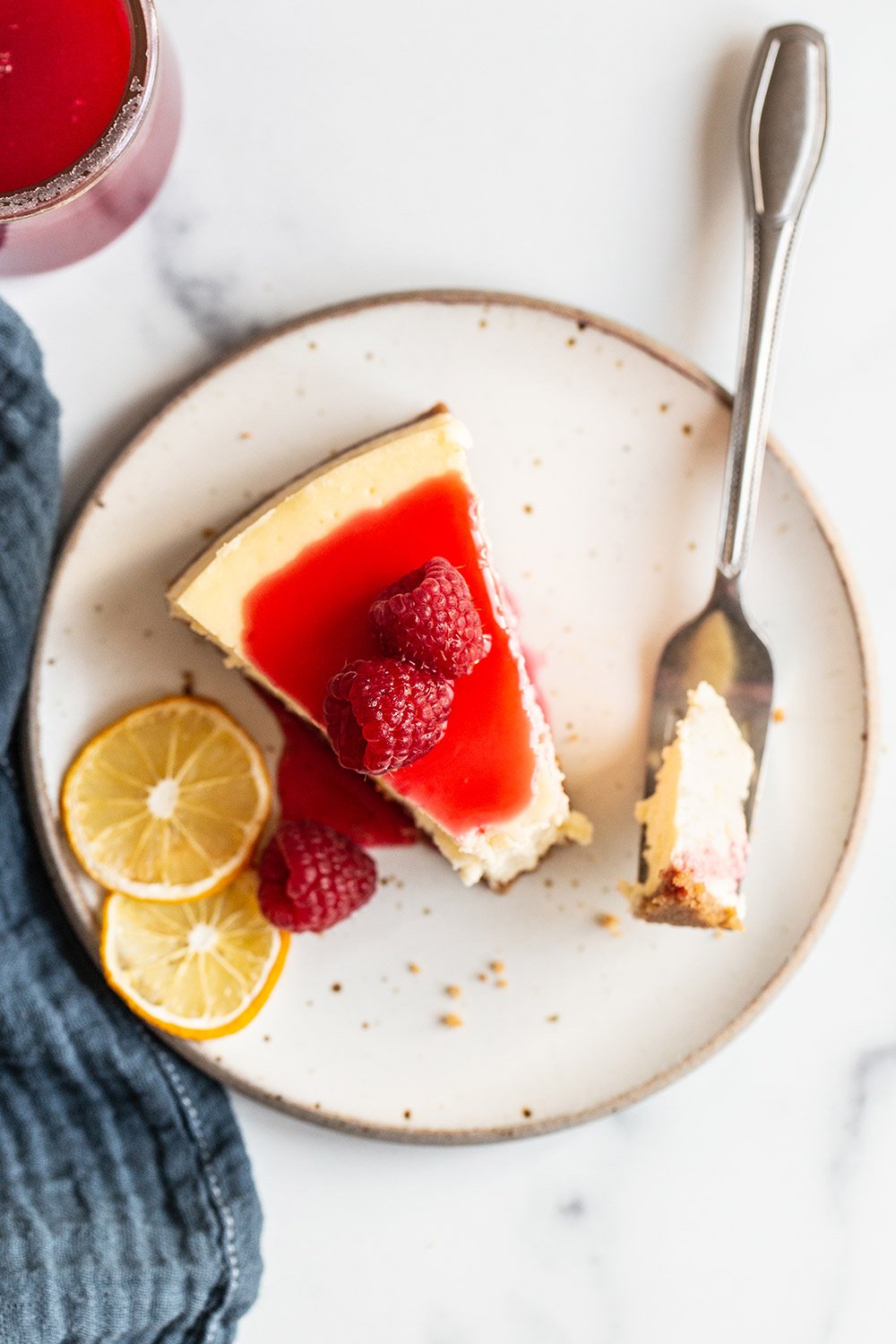
- In a small saucepan over medium heat, combine the topping ingredients. Heat, stirring and breaking up the raspberries often, until the raspberries release their juices and begin to form a syrupy sauce, about 5 to 10 minutes. Remove from heat. Using a spatula, press the sauce through a fine mesh strainer into a small bowl to remove the seeds. Let cool completely. Cover with plastic wrap and refrigerate for 1 hour before using. The sauce will be on the thin side.
- Release the cheesecake from the pan onto a cake stand or serving plate and top with any desired toppings. Slice using a big sharp knife, running under running hot water and wiping it off in between cuts, for clean slices. Serve.
Notes
This recipe was originally published in 2016 and has been updated with recipe improvements, additional recipe tips, and new photos. Photos by Ashley McLaughlin.


what brand/type of cream cheese is recommended?
Hi Jessica! Tessa and our team usually use full-fat Philadelphia cream cheese when testing our recipes!
Thanks for this classic cheesecake recipe. you really make me your fan.
How do you prevent the top of the cheesecake from browning?
Hi Lindsey! If you follow Tessa’s instructions here and use a water bath, your cheesecake should not brown on top, thanks to the super slow baking it will experience in the water bath. If you find that this is happening, it could be that your oven’s heat is coming from the top and it’s getting overbrowned because it’s too close. Try moving your oven rack down a little (typically the middle position is perfect) to give it a little more space and encourage the heat to circulate around the cheesecake, rather than concentrate it right on top. I hope that helps! Happy baking 🙂
I love this recipe! Cooling down right now. more to follow 🙂
thank you!!
I’ve made this cheesecake so many times and it always turns out so perfect!! My favorite is to do a double layer for the graham cracker crust… SO good!
I was just wondering, if I were to make mini like cupcake size cheesecakes, would a batch make enough for 12 mini cheesecakes?
Thank you!!
Hi Ashley! So glad you enjoy Tessa’s cheesecake recipe! There are instructions for mini cheesecakes baked in muffin/cupcake pans in the pink tip box, above the recipe 🙂 Let us know if you experiment with mini cheesecake pans, as we haven’t specifically tried this recipe in that style pan! Happy baking 🙂
I used a Kuhn Rikon push pan that seals out the water bath with a silicone seal, no leaks. The only thing I would add is vanilla extract.
This was delicious! The recipe is also pretty versatile. At my husband’s request, I subbed oreos for the graham cracker crust, added crumbled oreos to the filling, and made the topping with strawberries. It turned out great.
Made this last night. It is a creamy cheesecake. I subbed strawberries instead of raspberries in your sauce recipe just because it’s what I had in the fridge and it paired perfectly with it.
Thank you
I made this cheesecake recently, and I’m STILL thinking about it. It was that good! Whomever reads this and may still be feeling intimidated by making it, do not fret! Just take it slow, and do every single process. Have fun, enjoy the steps and it’ll turn out wonderful!
very good recipe. Have baked 3 times, followed directions wirh water bath..Cake didn;t crack.
Hi
Can you share link of heat safe oven bag that you use? How is it look like? Itsnot available in my country. I saw a bag for cook turkey in oven in amazon but people said itsnot use for baking.
I have tried heavy duty foil but it still leaked.
Thanks
Hi Goldie! Here is an example of oven-safe bags you can use to protect your cheesecake from the water bath as it bakes! I hope that helps. Happy baking 🙂
I made the cheesecake with water bath, and oven with convection. During the bake, many bubbles appeared on the top of the batter, and became brown. I stopped baking after 1 hour. Do you have any hint why the top turned to brown? Sugar? Overbaking? Thank you for your help.
Hi Sandra! Did you reduce the oven temperature when baking with your oven’s convection setting? Convection ovens typically need to be reduced by about 25°F when baking. The temp was possibly a little high, which is why your cheesecake browned. Alternatively, the oven rack may have been positioned too high in the oven, and too close to the heating element, causing the browning. Moving your oven rack to the center of your oven should help, if this was the cause. I hope this helps, Sandra! 🙂
First time making a cheesecake & it was a success! It was so delicious & tasted BETTER than Cheesecake Factory cheesecake. I ended up buying a silicone baking pan for $10 on Amazon to place my cake pan in for the water bath & it worked perfect. I suggest using the silicone baking pan over wasting foil paper & a baking bag, since they can easily rip & possibly destroy this delicious cheesecake! I can’t wait to make this cheesecake again!
So wonderful to hear that you loved this cheesecake so much, Dina – and such a great tip!!! 🙂