





Tessa Arias, Chef and Cookbook Author
This post may contain affiliate links. Read our disclosure policy.
Ovens: they’re such a crucial part of the baking process, but we don’t necessarily give them much thought.
That preheat ‘beep’ goes off and we throw in our cookies, brownies, or cake, set the timer, and walk away, right?
Well … not necessarily.
Unfortunately, most home ovens aren’t quite that simple and aren’t as reliable as we believe.
I get so many questions asking, “what went wrong?” when HTH readers try a recipe and it doesn’t turn out right. So many people think the recipe or their ingredients are to blame – and while that can be the case, oftentimes, it’s your oven’s fault your cookies turned out too flat, too crispy or burned.
Below, I’m using cookies to illustrate why becoming a little more familiar with your oven will help your baking more than you might think!
What You NEED to Know About Your Oven
Learn the three most important things to know about your oven and how to adjust, to be successful whenever you bake something in the oven.
1. Oven 101: Temperature
- The #1 fact to know about your oven: it’s lying to you about the temperature it’s really at.
- Many home ovens are off by 15°F, some by even 25°F or more!
- I’ve never had a home oven be 100% accurate.
- In fact, my new oven often tells me it’s preheated to the temperature I specified, when it’s actually 20°F cooler.
- It may not seem like a big difference, but baking at the wrong temperature can significantly alter your final product.
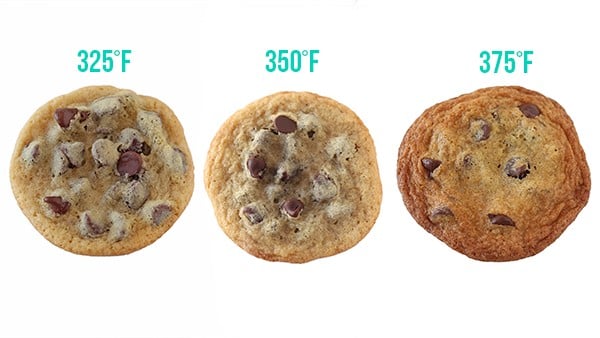
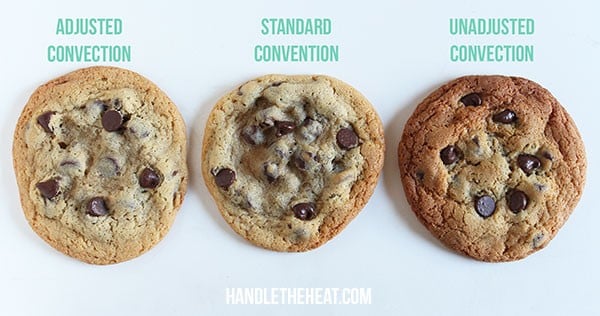
- In the image above, you can see what your cookies should look like if they’re baked at the correct temperature of 350°F, vs. how they’ll turn out if they’re baked at 25°F too cool or 25°F too warm.
- Too cool, and your cookies can overspread and not brown enough.
- Too warm, and your cookies may not spread enough, brown too much, and burn on the bottom.
- An oven thermometer is a necessity to make sure your oven is heating correctly.
- If your oven is not at the right temperature, you can adjust accordingly until your oven thermometer confirms it’s correct.
2. Oven 101: Placement
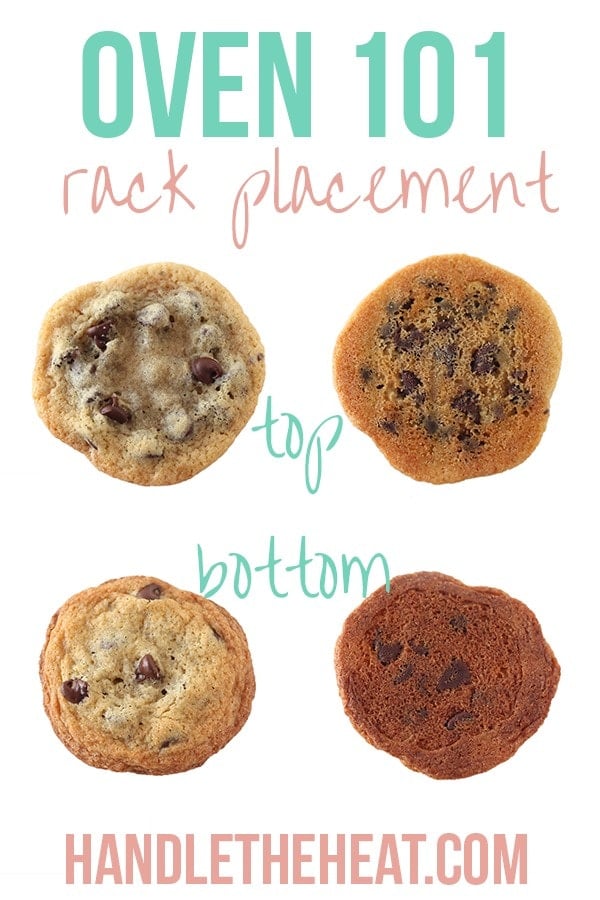
- The position of your oven rack can also have a surprising impact on your cookies.
- Certain recipes will specifically tell you where to position your oven rack, but most of the time it should be in the middle. Why? This is where the heat will be most even.
- If you bake your cookies (or anything) on the top rack, there won’t be as much browning.
- On the bottom rack, there will likely be too much browning.
- The same effect can occur when you’re baking multiple dishes at once. The other baking pans can block the heat from moving around freely and change the way the product is baked and browned.
- When possible, try to bake off one batch at a time instead of baking multiple pans at a time.
3. Oven 101: Conventional vs. Convection
- Unlike a conventional oven, which is the standard here in the U.S., a convection oven has a fan inside and an exhaust system that helps to circulate the hot air.
- This allows the oven to heat more quickly and evenly, and to bake more quickly and evenly.
- It’s more energy efficient and can even lead to better browning since the blowing air creates a drier environment.
- In many ovens, it also bakes so much more evenly, so you don’t need to rotate your baking trays.
When to Use Convection (if your oven has both convection + conventional settings)
- Convection is great for savory preparations like roasts or anything that is covered, like a braise or casserole.
- It can be good for cookies, pies, and pastries IF you make the proper adjustments (below).
- It’s NOT good for delicate foods like custards, soufflés, cakes, or quick breads.
How to Adjust
- If you’re using the convection (fan) setting in a recipe that doesn’t specifically call for it, be sure to drop the temperature 25°F.
- Also begin to check for doneness earlier, at least 2/3 or 3/4 of the way through the recommended baking time.
- Note that some convection ovens will automatically adjust the temperature when switching on the fan.
- Consult your oven manual if you’re unsure about yours.
More Baking Science Articles
- How to Cream Butter and Sugar
- How to Measure Flour
- Sugar 101: Everything You Need to Know About Sugar in Baking
- Baking Soda vs. Baking Powder
- How to Freeze Cookie Dough (& Bake From Frozen)


I’ve never heard a conventional oven called a convention oven before. My mental picture is of a bunch of ovens wearing name tags milling around in a large room. 🙂
I learned most of this on my own when they made me the baker several years ago. The convection oven instructions on the Otis Spunkmeyer Cookies were very specific. I am self-trained, but certainly believe baking=science and cooking=art.
Hi Tessa,
Thank you for your video. I am very new to baking and have a hard time trying to understand my new convection oven. I really throw away quite a bit of cookies and cupcakes because either too cook or not cook or partial cook (top cook, inside not cook).
My oven has a top tray, a bottom tray and a central tray with selection to select top heating or bottom heating or both heating. If I want to bake cookies and cupcakes, may I know should I use the top tray and top heating or place at centre tray with both top and bottom heating ?
Thank you Tessa, Very helpful info re: convection vs conventional oven. Was always confused if 50 or 25 degrees less than conventional, & clarifies that once & for all. Was uncertain until now which oven setting worked best. If or when time permits, wondering if you could address baking sheets. I purchased a top of the line thick (heavy) aluminum one. All the reviews said they were so great. They stopped the cookies from burning & all bake evenly, however took a lot longer to get them to appear “done,” plus noticed there was no crisp texture at the outer edges that we love. Crispy on the outside, chewy on the inside. Went back to my old thinner – baking sheets (1 is buckled but love the way baked good turn out on it vs the supposedly superior baking sheets).
Now this temperature difference could very well be the reason why I am so bad at cooking anywhere else besides my own home. I know my oven like I know the fingers on my hand – how much it takes to heat, which setting works best, how long it takes to properly cook. It’s too difficult for me to deal with uncharted territory!
Yes, exactly! When we moved to our new house I was at odds with our new oven for a few weeks. It’s definitely helpful to fully understand your own oven.
I am planning to buy a convection oven, but a bit worried for my cakes and cupcakes since I bake both for parties. Is there any way I can bake my cakes in a convection type? Thanks!
Most convection ovens should give you the option to turn the convection fan on or off, so you wouldn’t have to worry about your more delicate treats.
Thanks so much for this! The mystery has been solved! I am using a convection oven and I have been wondering why my actual baking time is always less than the ones indicated in the recipes I refer to…so do most recipes assume that one is using a conventional type of oven?
Great video, thankyou! I’m a lazy baker & put all the trays in the oven & cook as much as I can at once….and then I am always disappointed with my results! I’ll try to be a patient baker from now on!
AND… here in Australia, we have Convention ovens & Fan Forced ovens (we don’t call then convection ovens here!)
Glad you enjoyed! And I just spent most of March with family in Australia so I’m familiar by now. I have to say, it took me a while to figure out how to use their Aussie oven haha!
Thank you for the information on convection. My oven cooks both ways, but I never use the convection for fear of ruining what I am cooking. Now, I’ll give it a try!
I was afraid to use our new oven which cooks both ways at first too. I think you’ll grow to love the convection! So much faster and even cooking.
Thank you!! I am buying myself an oven thermometer asap!!
Yay!!
Why does my cookies go thin at the edges while I bake and what is the highest tempreture in an oven ….350°f??????
a little too much butter/shortening will cause thinning
I don’t have an oven at home so I use a countertop/toaster oven to bake my baked goods. Is it necessary to have an oven thermometer if I’m baking in a countertop/toaster oven
So useful! I’m sure my oven runs cold so I just mentally adjust